[SSR] 3. SSR - Data Fetch
December 07, 2019
Translated from the Korean original.
You’ll find the full code for this tutorial here.
Every bug I ran into while building this is logged here — look for issues tagged ✈️ SSR.
What this post covers
Here’s what we’re building in this post:
- Declare the business logic the client needs.
- Have the server carry out what step 1 defined.
- Hand the result of step 2 back to the client.
- Have the client use that data to initialize its store.
1. react-router-config
The server now needs to know about the behavior the client used to own, so we’re changing how routes get defined. Start by declaring a RouteBranch interface like this.
export interface RouteBranch { path: string; exact?: boolean; component: React.ComponentType<any>; loadaData?: (params: any) => any; routes: Array<RouteBranch>;}This defines what makes up a route (path, component, etc.) and captures the work that route has to do as a function called loadData.
The server will call this function to run its business logic later on.
Now let’s declare every route in the project.
const UserView = loadable(  () => import(/* webpackChunkName: "user" */ '../User'), { ssr: false });const OrgView = loadable(  () => import(/* webpackChunkName: "org" */'../Org'));
export const routes: Array<RouteBranch> = [  {    path: '/user',    component: UserView,  },  {    path: '/org',    component: OrgView,    loadData: (store: Store) => {      store.dispatch(        orgGitHub.fetch({          // fetch Data        })      )    }  },];
/user won’t be SSR-rendered, so naturally there’s nothing for the server to fetch, and we skipped loadData for it.
Look at the /org route, though, and it takes a store and dispatches an action.
Every piece of business logic in this project flows through action dispatch -> middleware -> store, so we kept it consistent with that.
The server is what hands this store in.
2. Updating server/app.tsx
Here’s what needs to happen on the server:
- Create a store.
- Inspect the route and run whatever loadData work it needs.
- Hand that result to the client.
Let’s put all of this inside handleRenderer.
const handleRender =(req, res) => {  try {    const appStore = getStore();
    loadBranchData(req.url)(appStore).then((data) => {      if (data.every((data) => data === null)) {        const config = getHtmlConfigs(req, appStore);        const { html, webExtractor } = config;        res.send(renderFullPage(webExtractor,html, {}));
        return;      }    });  } catch(e) {    // error handling  }}app.get('*', handleRender);
handleRenderer has to deal with two situations.
1. When the client has no business logic to run
Here we just finish rendering and ship it to the client. We check for this case with if (data.every((data) => data === null).
loadData returns null whenever it has nothing to do. So when every result from loadData comes back null, we treat that as no work at all and send the html straight back through res.send.
2. When the client has business logic to run
const handleRender = (req, res) => {  try {    const appStore = getStore();
    loadBranchData(req.url)(appStore).then((data) => {      if (data.every((data) => data === null)) {        // case 1      }      // case 2      const unsubscribe = appStore.subscribe(() => {        const config = getHtmlConfigs(req, appStore);        const finalState = appStore.getState();        const loadingKeys = Object.keys(finalState.loading);        const { html, webExtractor } = config;        const fetchState = new Array(loadingKeys.length).fill(false);
        loadingKeys.forEach((key: string, index: number) => {          const isFetched = finalState.loading[key] !== HttpStatusCode.LOADING;
          fetchState[index] = isFetched;        });
        const isAllFetched = fetchState.every((state) => state);        if (isAllFetched) {          unsubscribe();          res.send(renderFullPage(webExtractor, html, finalState));
          return;        }      });    });  } catch(e) {    // error handling  }};
Here’s what’s happening, step by step:
- Once we dispatch the action, we subscribe to the store so we know when it changes, and wait for the actual data to land.
- We build an array for fetchState, and mark an index true whenever that key’s loading-reducer status, pulled from the store’s finalState, isn’t
HttpStatusCode.LOADING. - Once every slot in that array is true, we
unsubscribefrom the store and send the html back.
This project keeps a dedicated loading reducer, which is why the code looks like this. Swap in whatever logic makes sense for checking fetchState in your own structure.
loadBranchData
So what is loadBranchData actually doing?
import { MatchedRoute, matchRoutes } from 'react-router-config';import { applyMiddleware, compose, createStore, Store } from "redux";import root from 'window-or-global';
import { routes } from '@/routes/controller';import epics from '@/store/epics';import reducers from '@/store/reducers';
export const loadBranchData = (pathname: string) => (store: Store) => {  // Get exact MatchedRoute.  const branch: Array<MatchedRoute<any>> = matchRoutes(routes, pathname);
  const promises = branch.map(({ route }) => (    route.loadData ? route.loadData(store) : Promise.resolve(null)  ));
  return Promise.all(promises);};
It takes pathname and store as arguments.
- pathname: finds whichever entry in the client’s routes array matches the route express just got asked for, using react-router-config’s
matchRoutesto do the matching. - store: the loadData functions defined on the client expect a store as an argument. We pass in the store the server built so that logic can actually run.
All of that work runs through Promise.all().
getStore
export const getStore = () => {  const epicMiddleware = createEpicMiddleware();  const composeEnhancers = (root as any).__REDUX_DEVTOOLS_EXTENSION_COMPOSE__ || compose;  const appStore = createStore(reducers, composeEnhancers(applyMiddleware(epicMiddleware)));  epicMiddleware.run(epics);
  return appStore;};
This is basically the same code we already wrote for creating the store on the client.
🍿(spoiler): the client-side function that builds the store is about to change too.
3. Passing the initial store value to the client
So far the server only runs the work the client declared and produces a result. Now we actually need to get that result to the client.
Following Redux’s Server Rendering docs, we’ll attach the state the server built to a window variable and pass it along that way.
export const renderFullPage = ( webExtractor: ChunkExtractor, html: string, preloadedState: RootStoreState | {},) => { return(` <!DOCTYPE html> <html lang="ko"> <head> <meta name="viewport" content="width=device-width, user-scalable=no"> <meta name="google" content="notranslate"> <title>soso template server</title> ${webExtractor.getLinkTags()} ${webExtractor.getStyleTags()} </head> <body> <div id="root">${html}</div> <script> window.__PRELOADED_STATE__ = ${JSON.stringify(preloadedState).replace(/</g,'\\u003c')} </script> ${webExtractor.getScriptTags()} </body> </html> `)}The initial state the server produced now lives on window.__PRELOADED_STATE__.
4. Initializing the store with data from the server
Here’s the client code that builds the store using that value.
import root from 'window-or-global';
export default (() => {  const preloadedState = root.__PRELOADED_STATE__;
  delete root.__PRELOADED_STATE__;
  const epicMiddleware = createEpicMiddleware();  const composeEnhancers = (root as any).__REDUX_DEVTOOLS_EXTENSION_COMPOSE__ || compose;  const store = createStore(    reducers, preloadedState, composeEnhancers(applyMiddleware(epicMiddleware))  );  epicMiddleware.run(epics);
  return store;})();
To work around window is not defined, we reached for
window-or-globaland usedrootin place of window.
We read the state the server already prepared off the root (window) variable and hand it to the store as it’s created. That’s what lets us initialize with state the server built ahead of time.
Checking it works
Everything we need is in place. Let’s see it in action.
This post doesn’t include the full code, so I’d read it alongside this PR.
npm startRun that in your terminal and open the /org page.
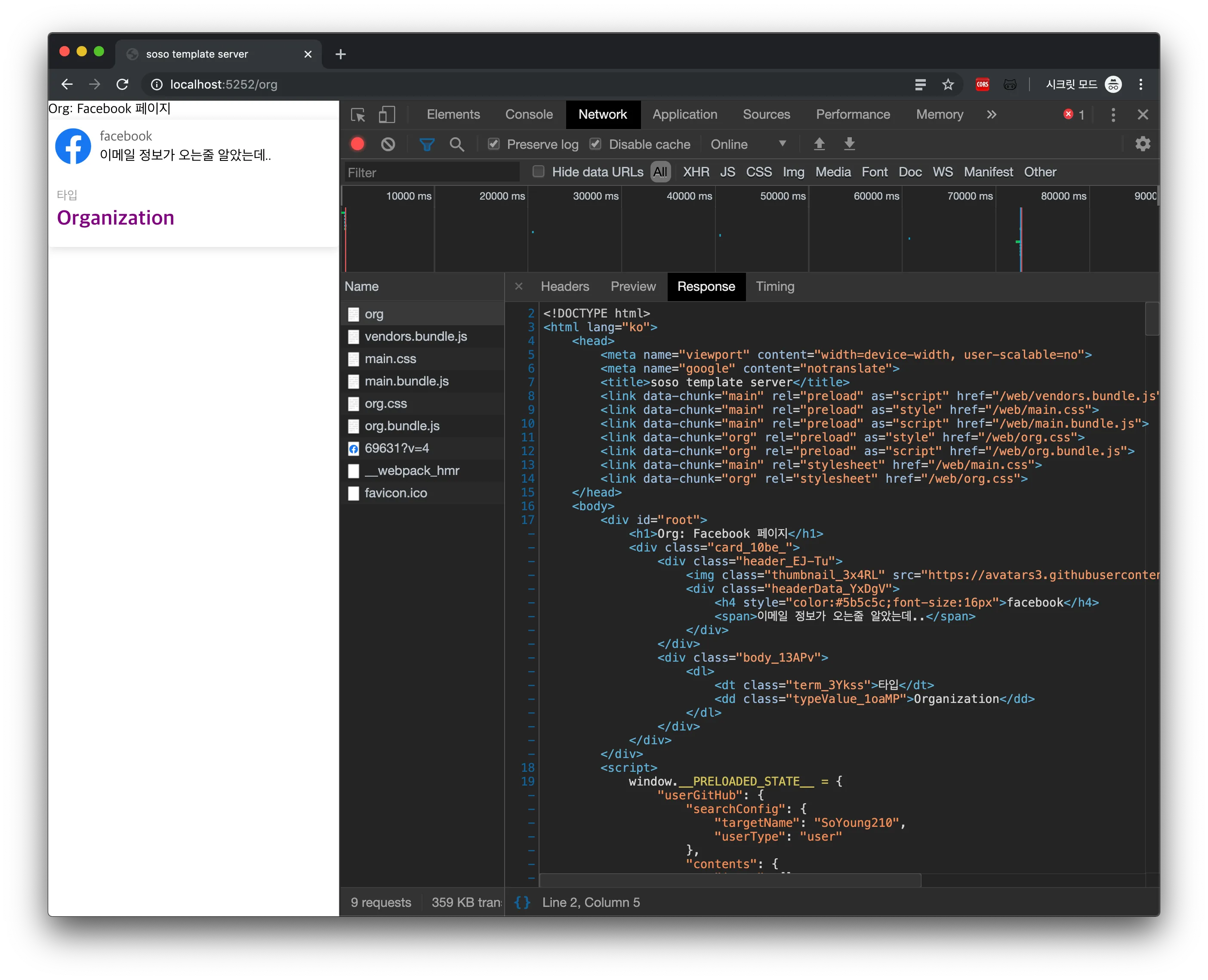 Before, only the header and a loading state ever came down the wire. Now the whole document arrives already filled with content.
Hit a given url, and you get back html with the content already drawn in, no loader involved.
Once you get here, though, a question creeps in: is skipping the loader entirely actually good UX?
So, that’s exactly what the last post in this tutorial digs into: SSR from a UX perspective.
